Strategic Plan
Introduction
Since 1997, Hope Solutions has established itself as the leading housing organization in Contra Costa County. Founded by a coalition of local faith communities, we are working to heal the multigenerational impact of homelessness, poverty, racism, trauma, substance use, mental health issues, and inadequate access to healthcare. To end homelessness, Hope Solutions takes a housing-first approach coupled with supportive services to bolster client success. We envision a world where everyone has a place to call home and the support of a strong community to live with dignity and reach their full potential. Hope Solutions values honest and collaborative relationships with clients and community partners, and we are committed to accomplishing our work with integrity, respect, compassion, and humility. Our mission is to heal the effects of poverty and homelessness by providing permanent housing solutions and vital support services to vulnerable families and individuals. Our data-supported and proven model is client-centered, reduces long-term homelessness, builds community, and breaks the cycle of poverty. As we look forward to the next few years, Hope Solutions remains keenly focused on deepening our impact, increasing our influence in the housing ecosystem, and investing in organizational capacity to expand our reach.
Retrospective
Hope Solutions provides permanent supportive housing and vital services to nearly 3,100 of our community’s most vulnerable members. We are proud of our accomplishments but recognize that more work must be done. Our last Strategic Plan was foundational in helping us expand permanent housing solutions and client-centered support, build capacity and systems to ensure organizational health, and effectively partner with government and the community for sustained impact.


THe landscape
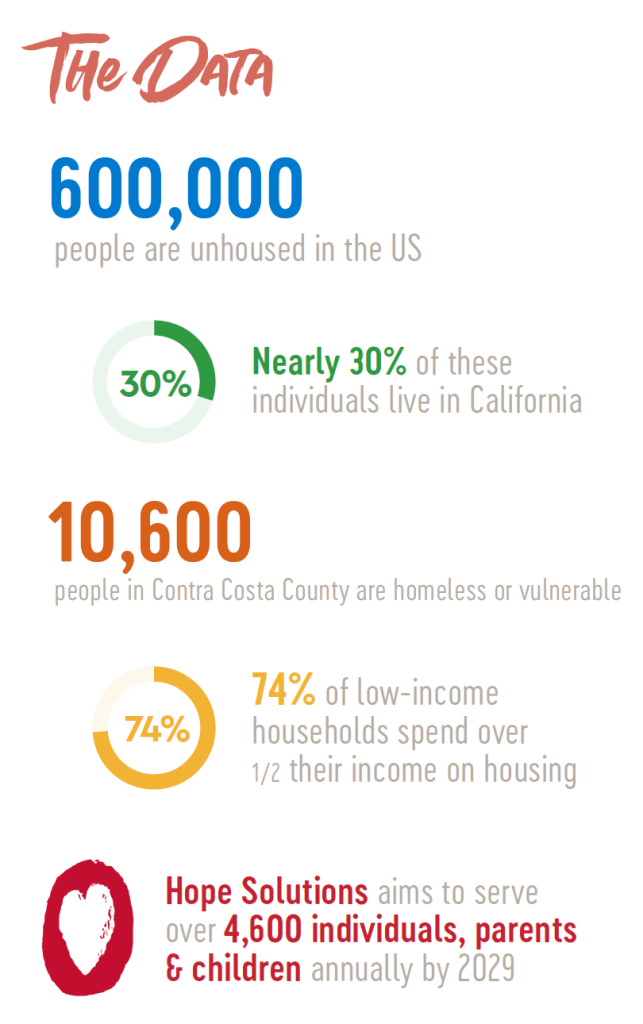
The primary cause of homelessness is the lack of affordable housing. Nearly 600,000 people are unhoused in the United States. Almost thirty percent, or 172,000, of these individuals live in California. Contra Costa County is feeling the weight of this crisis as it continues to experience high housing costs, a lack of affordable housing, and the need for better-paying jobs. With only a two percent vacancy rate, over 30,000 low-income renter households in the County do not have access to affordable homes. These issues are compounded by families, youth, and seniors needing more emergency and supportive services. Currently, 7,725 households (10,600) people are vulnerable to or experiencing homelessness in our community, a three percent increase since 2019. However, in 2022, Contra Costa County had only 1,136 beds available in the interim and permanent housing supply for persons experiencing homelessness. The spike in homelessness includes a thirty-two percent increase in households with children and a thirty-six percent increase in households with seniors. The stark gap between wages and the soaring cost of housing in the County underscores the challenges low-income households and people experiencing homelessness face when trying to secure stable housing and build back their lives. Renters in Contra Costa County must earn $42.69 per hour – nearly three times California’s minimum wage – to afford the average monthly asking rent of $2,200. Seventy-four percent of extremely low-income households in Contra Costa County are paying more than half their income on housing costs compared to zero percent of moderate-income households. Hope Solutions is uniquely positioned to meet these challenges, continuing to expand permanent housing solutions and client-centered support services in Contra Costa County. Our approach cost-effectively improves housing stability and health outcomes, increases independence, builds community, and breaks the cycle of poverty.
Strategic PRIORITIES
Hope Solutions’ resolve and commitment to Contra Costa County are unwavering. We are poised to leverage decades of experience to expand the number of clients we serve each year and use our expertise
to advocate for improved public service systems and increased resources. We will also continue to make deep investments in our staff by creating meaningful opportunities for professional development, building on a strong culture of diversity, equity, inclusion, and belonging. Four strategic priorities will drive our work to ensure more Contra Costa County residents experience accelerated outcomes in stable housing, good health, and increased income:


STRATEGIC PRIORITY #1: Expand permanent housing solutions
Expanding permanent housing solutions is a cornerstone of our Strategic Plan and the fight against homelessness. Permanent, safe, affordable housing provides individuals and families a crucial stepping stone towards regaining independence and rebuilding their lives. Permanent housing solutions are often more cost-effective than temporary interventions, as they reduce the strain on public resources and minimize the social and economic costs associated with homelessness.
With this in mind, two focus areas drive our efforts:
1. Increase permanent housing solutions for individuals and families by 50%
2. Increase the number of people who retain housing through homeless and eviction prevention services.
KEY GOALS
– Increase housing stock that Hope Solutions owns, leases, and or operates from 140 to 210 units by 2029.
– House and support over 2,000 households annually by 2029.
– Optimize cottage community development, ensuring six to eight projects are in the pipeline.
– Explore housing strategies to expand our capacity with transition-age youth and the re-entry population.
The Bay Area housing landscape is complex. Hope Solutions understands that increasing permanent housing solutions by 50% requires a multi-faceted approach that includes efforts to produce and preserve affordable housing stock while also expanding evidence-based models such as permanent supportive housing and rapid rehousing. We will increase the stock that we own or master lease by 50% from 140 to at least 210 units by exploring the acquisition/ rehabilitation of small housing clusters, master leasing suitable units, and building new housing through our cottage community strategy.
Additionally, we will expand the number of households receiving service-supported permanent housing from 1,352 to over 2,000 households per year by 2029 by expanding our successful permanent supportive housing and rapid rehousing programs for a range of vulnerable populations, including unhoused youth, families, individuals, seniors, and the re-entry population.
Central to our efforts to increase dignified, affordable housing stock for our clients is Hope Solutions’ efforts to create cottage communities with faith-based partners. We will advance new construction opportunities by honing our cottage community approach, refining the financial model, creating service delivery efficiencies, and leveraging
data to increase our learning and influence systems change. We will conduct a feasibility study to support our planned expansion, identifying additional faith-based land and surplus land inventory. With a refined cottage community model and robust data from the feasibility study, Hope Solutions plans to develop a pipeline of projects, readying
a subset of these projects for funding.
In support of our permanent supportive housing and rapid rehousing work, we will refine our approach, determine our capacity needs, set growth targets, and continue to foster sustainable relationships with property owners. We will also innovate and test bridge housing opportunities and youth villages for the growing populations of unhoused transition-age youth and formerly incarcerated clients reentering our community.\
KEY GOALS
– Increase resources to support homeless and eviction prevention services.
– Work with community partners to develop a coordinated and streamlined system for supporting prevention work.
Eviction prevention initiatives are critical for ensuring housing stability and reducing homelessness, particularly among vulnerable populations facing economic hardship. These programs offer a lifeline to individuals and families at risk of losing their homes due to financial instability, job loss, illness, or unforeseen emergencies. One of the primary benefits of eviction prevention efforts is the ability to address housing instability at its root, helping to keep individuals and families housed and preventing the disruptive and traumatic experience of eviction and homelessness. y providing landlord mediation, problem solving, and or direct financial assistance, Hope Solutions will help hundreds of households cost-effectively maintain their housing stability. The eviction prevention services ecosystem is still forming in our County. To support the development of an efficient and effective prevention system of care, Hope Solutions will incorporate best practices from the field and share our data and learnings with community partners and policymakers to ensure this much-needed intervention is prioritized within our broader system of care.
STRATEGIC PRIORITY #2: Increase impact by enhancing client-centered support services.
Permanent, dignified housing is the foundation upon which families and individuals reach their full potential. Hope Solutions understands that the work does not stop once someone is housed. The provision of client-centered services, encompassing a range of supports such as clinical services for mental health and wellness, education and employment assistance, youth enrichment programs, and case management, play a vital role in addressing the multifaceted needs of individuals who are at risk of or are experiencing homelessness.
KEY GOAL
– Improve client outcomes through enhanced service delivery in physical and behavioral health, education, and employment services.
Holistic, personalized support tailored to individual circumstances is essential in supporting our clients’ overall health and wellness. Hope Solutions is dedicated to refining our service delivery to ensure every client has access to robust physical health support as well as interventions that address mental health needs and substance use. qually, we plan to increase our impact on individuals and families by deepening our investment
in education and employment services. The workforce continues to evolve, and studies reveal that by 2031 postsecondary training beyond high school will be a requirement to participate in the labor force. Hope Solutions must ensure that we are partnering with our clients to help them prepare for the jobs of the future. Planned services include financial literacy, workforce readiness, and support in achieving a high school diploma and pursuing post-secondary education.
As we refine services and integrate new supports, we plan to leverage data to learn what interventions have the greatest impact while infusing our work with evidence-based practices gleaned from the larger field of behavioral health, education, and employment services. Determining the optimal stang needs will be another primary focus to ensure services are sucient to deliver the level of support our clients need to be physically and
emotionally well and prepared for success in school and careers.
STRATEGIC PRIORITY #3: Influence the public funding and service systems to increase resources to prevent and end homelessness..
Strengthening our position as a leader and partner of choice in the housing sector requires more than compelling program outcomes. Hope Solutions must also leverage our impact data to influence policies that improve systems of care, increase resources to help expand permanent housing, and allow for enhanced client-centered services. Centering front-line experience and residents’ voices, Hope Solutions will unlock more public revenue, fundamentally improve the public service systems that directly impact our client community and support our housing development efforts.
KEY GOALS
– Strengthen our position as a leader and partner of choice in the housing sector.
– Leverage program impact to influence public decision-makers to support a more effective, just housing and
homeless service system.
– Create a policy platform and strengthen staffing to lead our advocacy efforts.
– Publish learnings and highlight our housing development and policy efforts.
Creating a more efficient and just housing and
homeless services ecosystem requires a thoughtful
approach to external education, advocacy, and policy
work. To further advance our efforts, Hope Solutions
will create a strong practice-to-policy framework
based on compelling program data to educate
policymakers and stakeholders about the power and
impact of our approach.
To ensure our advocacy efforts are productive, Hope
Solutions will identify strategic collaborative partners
to amplify our work and create a targeted influence
map outlining which decision-making bodies have
the most power over funding streams that can
support our growth. Additionally, we will adopt a
policy platorm annually and strengthen our staff
capacity to drive advocacy efforts. Advancing the
larger field through our systems change efforts will
naturally elevate Hope Solutions as a leader in the
housing development and homeless field, opening
doors for additional partnerships and funding.
KEY GOALS
– Expand our policy influence through partnerships with people with lived experience.
– Ensure people with lived experience inform program design and service delivery.
– Strengthen strategic external community organizing efforts in support of system redesign.
– Assemble a lived experience advisory group to inform our governance and operations.
Influencing systems is only possible with the voices,
insights and experiences of people with lived
experience (PWLE). Hope Solutions is committed
to continuing our collaborative and meaningful
partnerships with PWLE to help enhance programs
and service delivery, develop a policy platform, and
ensure our practice-to-policy framework is informed
by those individuals directly affected by systemic
inequities that cause and perpetuate homelessness.
Hope Solutions is committed to collaborative
community leadership. We will engage in local, state,
and federal policy education and advocacy, including
community organizing, to smartly further our goals
to support systems redesign. Hope Solutions will
prioritize collaborations with the county and expand
the Resident Empowerment Program (REP) role in
our advocacy efforts. We will create a space where
members of the REP and other people with lived
experience can share their stories at public and
private events to help raise awareness of key issues
that impact unhoused members of our community.
Internally, we will assemble a lived experience
advisory group to inform our governance and
operations and strengthen internal support for staff
with lived experience
KEY GOALS
– Position Hope Solutions for new, sustainable public funding at the federal, state, and local levels.
– Leverage program efficacy and impact to direct more existing resources to support planned growth.
Our impact is driven by learning, innovation, and the
public revenue required to sustain current and future
efforts. Hope Solutions will unlock new federal, state,
and local revenue aligned with our client-centered
and data-supported approach. This may look like
increasing the number of housing vouchers available
for our cottage communities, helping expand housing
vouchers for foster care youth, or supporting state
and regional housing measures to increase public
dollars dedicated to the creation of permanent
affordable housing.
sing our practice-to-policy framework, Hope
Solutions also plans to highlight the ecacy and
impact of our programs to direct more existing
resources to support planned growth. For example,
we will explore leveraging new revenue from CalA,
Californias multi-year plan to transform the edi-Cal
program and make it integrate more seamlessly with
other social services, to bolster the services funding
required for clients to sustain permanent housing.
STRATEGIC PRIORITY #4: Strengthen organizational excellence for continued growth.
Internal strength leads to greater external impact and sustainable growth in future years. The greater our ability to create a supportive organization that addresses the needs of our staff and Board members, the more effective we will be at offering the same support to our clients. Hope Solutions will invest more resources into our critical infrastructure while strengthening private fundraising. Increased unrestricted revenue will allow us to innovate, implement a comprehensive model of care, unlock new learning from sophisticated data analysis, and support opportunities to expand our reach.
KEY GOALS
– Implement an integrated talent management strategy incorporating a staffing structure for current operations and future growth.
– Continue to foster a culture of support, diversity, equity, inclusion, and belonging.
– Develop succession planning for all key leadership roles.
Our people are our strength. Hope Solutions is dedicated to continuing to build a skilled team that can effectively carry out our mission and adapt to evolving challenges. Investing in staff development, fostering a positive organizational culture, and attracting passionate individuals committed to the cause are essential to sustaining an effective, diverse, and inclusive workplace. Hope Solutions plans to implement complementary approaches for investing in staff, including a robust talent management strategy to inform the scoping and hiring of key positions that support current operations and planned growth. We will refine our hiring, onboarding, and retention practices, sharpen our recruitment processes, enhance staff performance management and accountability, and offer leadership development pathways for personal and professional growth. With an eye to sustainability, we will develop succession plans for all senior leadership team members and continue to support retention by offering competitive compensation. Additional priorities include exploring an emerging leaders program for managers and direct service staff.
KEY GOALS
– Refresh and update centralized technology systems across departments to improve collaboration and effciency.
– Create standard operating procedures for all departments.
A robust infrastructure supports scalability and ensures staff can work effectively and efficiently. From technology infrastructure to administrative processes, efficient systems streamline operations, enhance productivity, and allow us to focus our resources on healing the effects of poverty and homelessness. We will assess technology needs across departments, source new vendors for respective database platforms, determine the sequence and cadence for implementation, and explore tools to streamline internal communications. Hope Solutions will finalize standard operating procedures for programs in alignment with our proven model of care and optimize policies and procedures in our development, Finance, and Administration departments to codify work across teams.
KEY GOALS
– Develop a scorecard to track organizational health and performance
– Update all board governance processes and documents.
Strong board governance is essential in helping guide Hope Solutions through sustainable growth and towards long-term success. As Hope Solutions invests in staff and vital operations to grow, we will also continue to cultivate a strong board with a shared vision and a commitment to the organization’s mission. We will continue to prioritize fostering a diverse and skilled board that brings expertise, lived experience, networks, and resources to help Hope Solutions optimize our ability to serve and support the community. To remain nimble and responsive to the organization’s evolving needs, the board of directors will work with executive leadership to create a scorecard to track organizational performance across key domains such as program impact, financial health, and fundraising goals. The board will also inventory and update all governance documents and define and foster the optimal board culture. The board will continue to prioritize staying connected with staff to remain close to the community and to the issues that impact the work of Hope Solutions. Additional activities to enhance board governance include updating the onboarding process, identifying boardsmanship training, and ensuring the board represents our values of diversity, equity, inclusion, and belonging.
KEY GOALS
– Launch a growth Campaign to support investments in organizational growth and enhanced programming.
– Implement new strategies to increase unrestricted operating funds.
– Expand brand awareness at the local, regional, and state levels.
Unrestricted, multi-year revenue allows innovation, unlocks new growth opportunities, and is foundational in creating a sustainable and diversified funding portfolio. Hope Solutions plans to launch a growth Campaign to expand our reach, refine programs, and increase our housing stock. Conducting a landscape analysis to sharpen the work of the development and external relations department will be instrumental in formalizing new strategies to increase unrestricted operating funds and to better position the organization as the nonprofit of choice for wealth managers and local donor-advised funds. To expand our brand visibility, Hope Solutions will publish an annual impact report highlighting our outcomes and system-influence efforts to share with key stakeholders.
KEY GOALS
– Implement a revised Theory of Change that aligns service delivery and staffing with intended impact.
– Leverage proactive, high-quality data to sharpen decision-making.
– Clarify key data points and dashboards that support the development of an annual impact report.
Hope Solutions is poised to increase our support to families and individuals, helping them leverage their innate resilience and skills on the road to permanent stability. Specifically, we plan to refine and test our model of care, or Theory of Change, to make clear the role quality permanent housing, behavioral health, and education and employment services play in achieving our intended impact. Data will continue to play a critical role in holding ourselves accountable to the community, empowering staff, and articulating our unique value add to funders, policy-makers, and allies. By setting clear goals, measuring outcomes against benchmarks, and continuously evaluating and improving programs, we will continue to ensure that our efforts lead to meaningful and lasting change.